


 22.05.2025
 341
341
 Yangilik
ACTIVITIES OF THE ENGINEERING FEDERATION OF UZBEKISTAN IN THE DEVELOPMENT OF ENGINEERING IN THE REPUBLIC
Today, Uzbekistan is one of the most dynamically developing independent states in Central Asia. Unique natural and climatic conditions, rich mineral resources, developed agriculture and powerful labor potential served as the basis for the creation of a diversified national economy in the Republic of Uzbekistan with priority development of not only the agricultural sector, but also a powerful industry. Members of the Engineering Federation of Uzbekistan are actively involved in solving engineering problems of the economy of Uzbekistan. Based on the issues discussed at the last meeting of the International Academy of Engineers, priority tasks of the Engineering Federation of Uzbekistan for 2024-2030 were determined. To develop a water resources management strategy and develop the irrigation sector in Uzbekistan for 2021-2030, International Academy of Engineers academicians A.V. Kabulov and I.Kh. Normatov have planned projects to monitor the use of water resources for agriculture, taking into account environmental factors and modeling the hydrogeological situation of the Aral region.
As part of the creation of a scientific school in the field of automation of the process of studying thermoelastic processes of nonlinear deformation of composite elements of spatial structures under the leadership of the corresponding member of the International Academy of Engineers A.M. Polatov and his students, a number of works are being carried out to study the influence of temperature and force loads on the stress state of fibrous materials, which are widely used in rocket science, nuclear power engineering and mechanical engineering.
Currently, he is conducting research in an important area of modern scientific and technical research such as the construction of adequate computational models of the functioning of various engineering structures that are exposed to force and temperature effects. It is known that the complexity of the geometry of the objects under study and the consideration of real types of loads, as a rule, involve the use of numerical methods and computers to assess their heat exchange process and deformation of materials. The goal of A.M. Polatov's research is to create mathematically sound methods, algorithms and software for the development of automation tools for the design of modern materials and structures. Corresponding Member of the International Academy of Engineers, Doctor of Engineering Sciences, Professor U.S. Nazarov is a highly qualified scientist and specialist in the field of development and operation of oil and gas fields, improvement of technology for increasing oil and gas production. He was awarded the "30 Years of Independence of Uzbekistan" badge and an honorary diploma for many years of dedicated and productive work in training and developing personnel for the oil and gas industry.
In order to find scientific and technological solutions to eliminate the ongoing long-term decline in natural gas and gas condensate production from the fields of Uzbek neft gaz JSC, U.S. Nazarov carried out research and development work in 2021-2024 to analyze the development status of 86 large and medium-sized gas condensate fields operated for 40-50 years in conditions of depletion of reservoir energy and a significant decrease in their production capabilities of the Shurtan neft gaz and Mubarek neft gaz fields. Also, the studies covered fields with relatively small geological reserves of hydrocarbon raw materials in order to clarify their current geological reserves and determine the possibilities of increasing production rates, in the presence of geological uncertainties in the concentration of natural gas in multi-layer underground reservoirs at 21 fields of the Gazli group (Gazli neft gaz ). The work was implemented at the fields of Uzbekneftegaz JSC. In addition, Academician of the MIA B.M. Tursunov actively participates in organizing the Tashkent Science Veterans Club and is a member of the editorial board of two journals:
Under the supervision of Academician of the International Academy of Engineers Khakimov M.Kh., work was carried out on the project "Development of a database, algorithms and software products, a computer translator environment based on NLP technologies and a multilingual simulated computer translator. Within the framework of this project, logical-linguistic and mathematical models of a computer translator were developed that translates scientific texts in six areas of automatic translation. During this period, he published the 2nd expanded edition of the textbook "English-Russian-Uzbek explanatory dictionary of terms and expressions on computer knowledge", containing more than 8600 paragraphs of vocabulary units.
Academicians of the International Academy of Engineers, professors of the Tashkent Transport University S.M. Kadirov and O.S. Kadirova prepared for publication a Russian-English technical dictionary (on automobile and tractor engines and automobile manufacturing) in 2 volumes (volume 700 pages) and a Russian-English-Uzbek technical dictionary in six volumes (volume 2000 pages). In 2018, a Patent for the industrial design "Passenger car" No. SAP 01739 was received. Thus, within 3 years, they created the first Uzbek passenger car "SANO", it was installed in the Polytechnic Museum "UZAVTOSANOAT" at the exhibition.
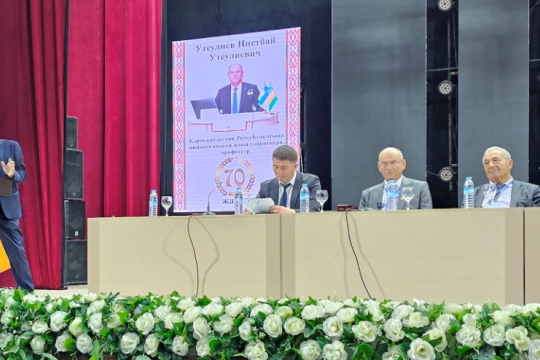
With in the framework of the creation of a scientific school in the field of mathematical modeling of natural processes and modeling of the problem of tomography and geophysics using the problem of integral geometry, a number of works are being carried out under the leadership of Corresponding Member of the International Academy of Engineers Uteuliyev N. U., investigating the issues of the methodology of ecological and economic modeling and its application in solving important applied problems of the interstate level, as well as the application of the problem of integral geometry in medicine and geophysics. Currently, research is being conducted in an important direction of the problems of integral geometry and its application in medicine, geophysics, research of the deterministic and stochastic mathematical model of the processes of cleaning polluted waters.
Academician of the International Academy of Engineers and the Academy of Sciences of the Republic of Uzbekistan Kh.Z. Igamberdiev formed a large scientific school in the field of the theory of regular identification and synthesis of adaptive control systems for complex dynamic objects. Significant results have been achieved in the field of identification of dynamic objects.
Currently, he is conducting research on the development of algorithms for stable stabilization of a linear uncertain dynamic object based on iterative algorithms; an adaptive control system with a multilayer neural network under parametric uncertainty; formalization of the procedure for selecting the optimality criterion and setting the problem of controlling the production of ammonium nitrate; stable simplified computational procedures for the synthesis of multidimensional control systems with incomplete information; regular algorithms for identifying the transition matrix of control objects under parametric uncertainty; stable algorithms for identifying controlled objects under uncertainty; algorithms for stable restoration of uncertain input actions based on operator equations; algorithms for stable restoration of uncertain input actions based on dynamic filtering methods, as well as the application of the developed algorithms for stable restoration of uncertain input actions in control problems of specific technological objects. Academician of the MIA and the Academy of Sciences of the Republic of Uzbekistan A. Zakhidov created a recognized scientific school on the theory, calculations and technology of manufacturing optical-energy concentrating solar radiation systems. Scientific and applied achievements of R.A. Zakhidov's school were used in the construction of a unique Large Solar Furnace in the Tashkent region, Parkent village (Uzbekistan), in the focal zone of which refractory and fireproof ceramic materials with specified properties are smelted at temperatures up to 3000 ° C. An autonomous combined solar-wind installation for powering the Charvak relay station was developed and built in a mountainous area. Academician R.A. Zakhidov was the scientific and technical director in the development and construction of the Solar Furnace for the testing ground of the United Institute of High Temperatures of the Russian Academy of Sciences in Makhachkala (Russia), as well as simulators of cosmic solar radiation for pressure chambers.
For 14 years, he participated as a national expert in the implementation of programs in the field of renewable energy (through the UN European Commission, UNECE) and in the field of energy efficiency (through the UN Economic and Social Commission for Asia and the Pacific, ESCAP).
The Engineering Federation of Uzbekistan held an international conference of al-Khwarizmi in 2021, dedicated to the 100th anniversary of the outstanding scientist, the first President of the Engineering Federation of Uzbekistan, academician of the International Academy of Engineers V.K. Kabulov. The Engineering Federation of Uzbekistan proposes joint scientific research:
Increasing the service life of automobile and tractor engines in hot climates, high altitudes and high dust levels;
Creating a passenger car and hybrid buses;
Revival of the Great Silk Road, its impact on the development of the modern economy and attitude to the historical and cultural heritage in the countries of Eurasia;
Dissemination of the Uzbekistan model for assessing and reducing the risk of educational buildings during earthquakes and solving engineering problems of preserving and restoring historical architectural monuments;
Assessing the efficiency of using large hydraulic structures throughout the Central Asian region;
Monitoring the use of water resources for agriculture, taking into account environmental factors and modeling the hydrogeological situation of the Aral region.


 Uzbek
Uzbek  Russian


 Print
Print Share Page